
The Urticaria Storm: Investigating Chronic Hives & Modern Mast Cell Control
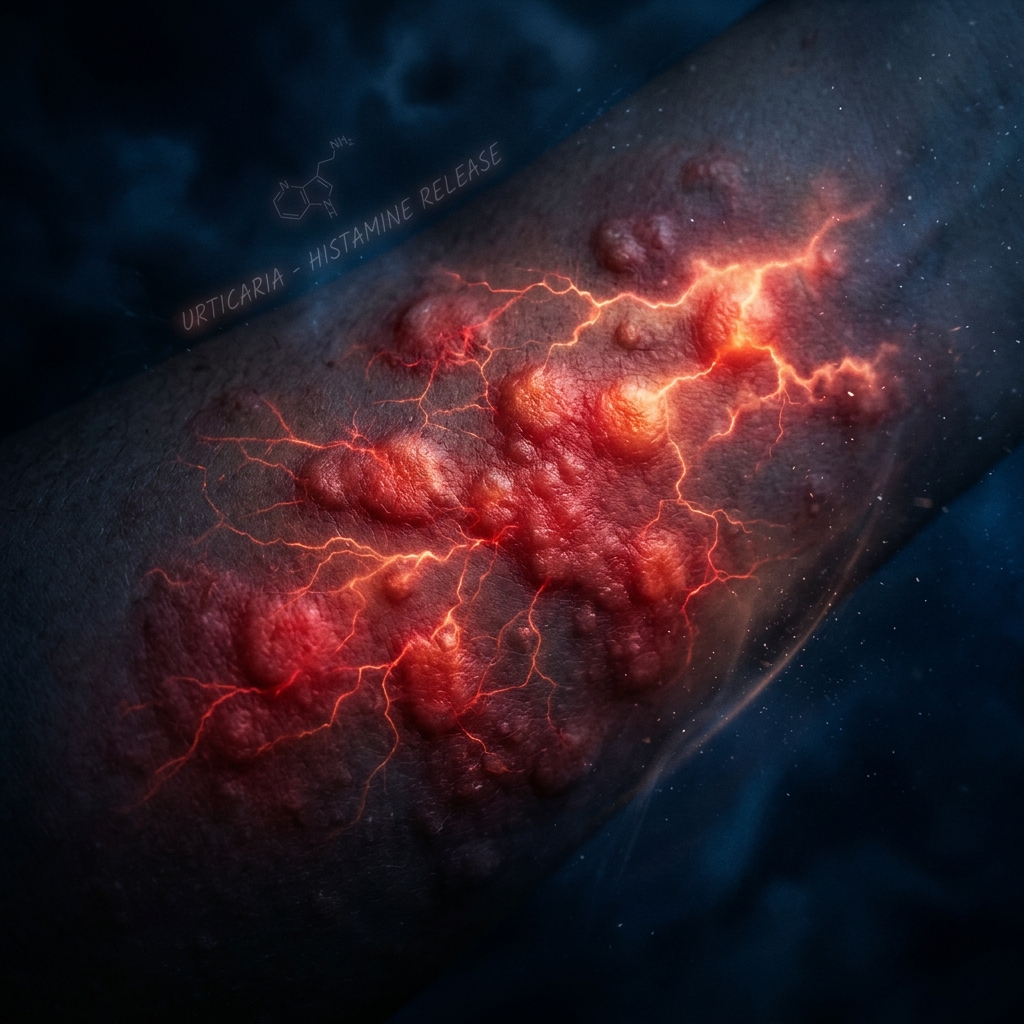
Urticaria (hives) is characterized by transient, intensely pruritic wheals with central pallor and surrounding erythema. When these hives persist daily or near-daily for more than six weeks, they enter the realm of Chronic Spontaneous Urticaria (CSU).
The Mast Cell De-granulation Cascade
The central effector cell in urticaria is the cutaneous mast cell located in the superficial dermis. Upon activation, mast cells undergo immediate degranulation, releasing pre-formed histamine along with prostaglandins and leukotrienes. These mediators trigger local capillary vasodilatation and sudden hyper-permeability, leaking fluid into the superficial dermis to form a wheal, or into the deep dermis and subcutaneous tissues to produce angioedema.
The Autoimmune Basis of Chronic Urticaria
Contrary to widespread belief, over 80% of chronic urticaria cases are not caused by external food or environmental allergies, but by internal autoimmune mechanisms:
- Autoantibody Type I (Auto-allergic): Circulating IgE autoantibodies directed against self-antigens like Thyroid Peroxidase (TPO) or IL-24.
- Autoantibody Type IIb: IgG autoantibodies directed directly against the high-affinity IgE receptor (FcεRI) or against IgE itself on the surface of mast cells, cross-linking receptors and triggering continuous degranulation.
Step-Wise Treatment Protocol (EAACI / GA2LEN Guidelines)
Modern clinical management follows clear international guidelines:
- Step 1: Standard-dose second-generation non-sedating H1-antihistamines (e.g., Bilastine, Fexofenadine, Levocetirizine).
- Step 2: Up-dosing the second-generation H1-antihistamine up to four times the standard licensed dose to overcome elevated histamine levels without sedating effects.
- Step 3 (Targeted Biologic): In refractory cases, Omalizumab (anti-IgE monoclonal antibody) binds circulating IgE, down-regulates FcεRI receptors on mast cells, and achieves complete control in over 85% of previously unresponsive patients.
Frequently Asked Questions
How long does an individual urticarial wheal typically last?
A classic urticarial wheal resolves within 2 to 24 hours without leaving permanent marks or bruising. If individual lesions persist in the exact same spot for longer than 24 hours and leave hyperpigmentation, urticarial vasculitis must be investigated with a skin biopsy.
Is angioedema dangerous?
While peripheral angioedema of the lips or eyelids is distressing but benign, involvement of the tongue, uvula, or larynx is a medical emergency requiring immediate intramuscular epinephrine to prevent airway compromise.

Dr. Ammar Al-Jarrah (MRCP UK)
Author & Clinical ReviewerConsultant Dermatologist, Trichologist & Laser Surgery Specialist
Member of the Royal College of Physicians of the United Kingdom (MRCP UK). Specializes in complex dermatological conditions, digital dermoscopy, scalp disorders, and fractional laser reconstruction. All articles undergo scheduled clinical reviews aligned with peer-reviewed medical guidelines.
- British Association of Dermatologists (BAD) : Clinical Guidelines for the Evidence-Based Management of Cutaneous Conditions & Laser Interventions.
- Journal of the American Academy of Dermatology (JAAD) : Procedural algorithms, digital dermoscopy standards, and atrophic scar remodeling protocols.
- European Academy of Dermatology and Venereology (EADV) : Consensus on biologic therapies and surgical scar revision therapies.
Related Clinical Articles
View All

Consult with Dr. Ammar Al-Jarrah
Book a comprehensive consultation at our clinic for accurate diagnosis and tailored medical care.